
Close Menu
    Facebook X (Twitter) Instagram
    SciTechDaily
    • Biology
    • Chemistry
    • Earth
    • Health
    • Physics
    • Science
    • Space
    • Technology
    Facebook X (Twitter) Pinterest YouTube RSS
    SciTechDaily
    Home»Physics»Microscopic Masterminds: The Structural Genius of Bacteria
    Physics

    Microscopic Masterminds: The Structural Genius of Bacteria

    By Max Planck Institute for Dynamics and Self-OrganizationOctober 10, 2023No Comments3 Mins Read
    Facebook Twitter Pinterest Telegram LinkedIn WhatsApp Email Reddit
    Share
    Facebook Twitter LinkedIn Pinterest Telegram Email Reddit
    Colorful Bacteria Petri Dish Concept Art
    Scientists at MPI-DS reveal how bacterial interactions lead to complex patterns and introduce a versatile model that can decode collective behaviors in various entities, from bacteria to robotic swarms.

    A new model demonstrates that chasing interactions can induce dynamical patterns in the organization of bacterial species.

    Structural patterns can be created due to the chasing interactions between two bacterial species. In a new model, scientists from the Max Planck Institute for Dynamics and Self-Organization (MPI-DS) describe how interactions on the individual level can result in a global self-organization of species. Their findings provide insights into general mechanisms of collective behavior.

    In a recent study, scientists from the Department of Living Matter Physics at MPI-DS developed a model describing communication pathways in bacterial populations. Bacteria show an overall organizational pattern by sensing the concentration of chemicals in their environment and adapting their motion.

    The Structure Only Becomes Visible on a Higher Level

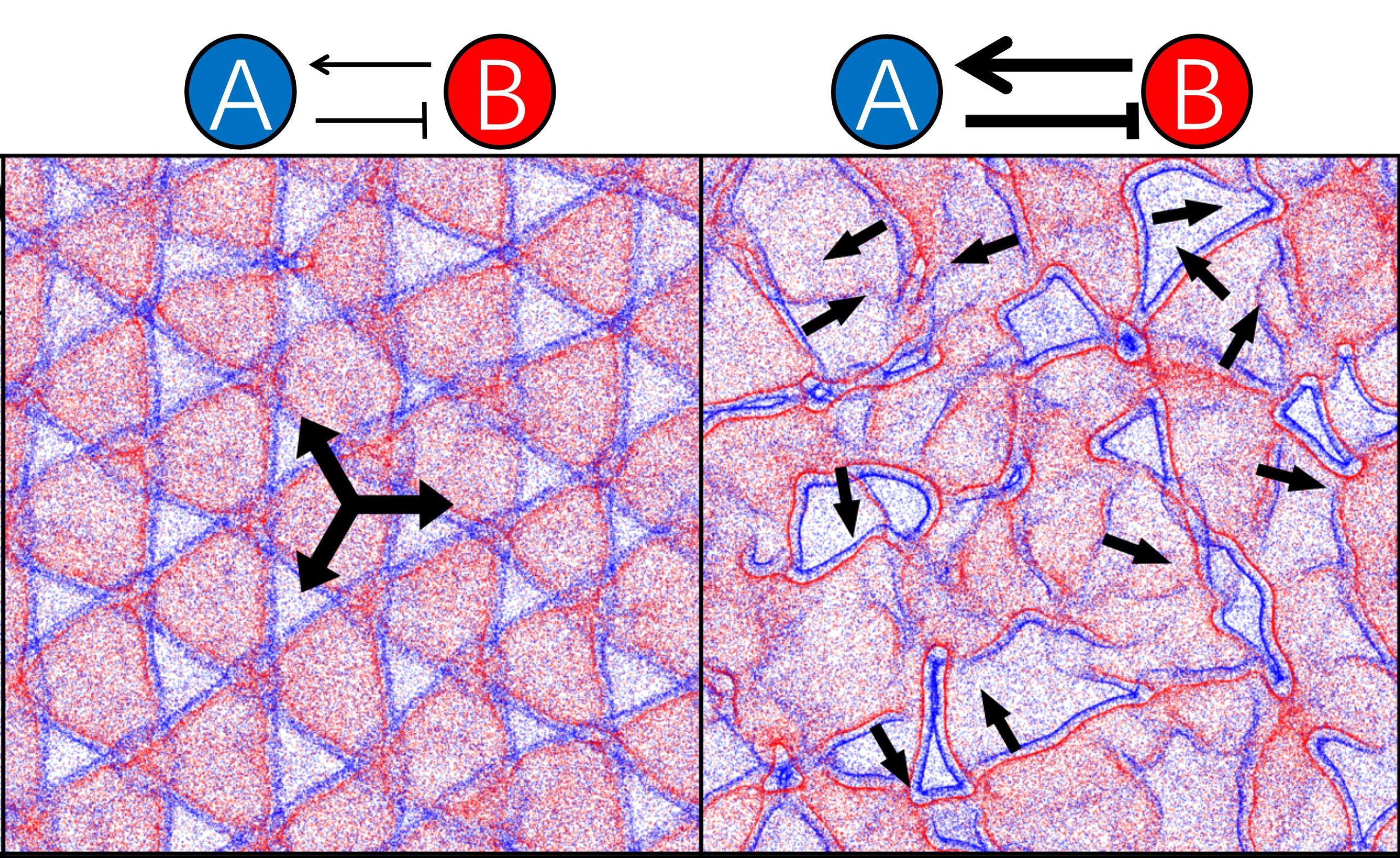
    “We modeled the non-reciprocal interaction between two bacterial species,” first author Yu Duan explains. “This means that species A is chasing species B, whereas B is aiming to repel from A,” he continues. The researchers found, that just this chase-and-avoid interaction is sufficient to form a structural pattern. The type of the resulting pattern depends on the strength of the interaction. This complements a previous study, where a model was proposed that also included intraspecies interactions of the bacteria in order to form a pattern.
    Patterns of Self-Organization
    Depending on the chase-and-avoid interaction between two species, A and B, different patterns of self-organization can evolve on the global level. Credit: MPI-DS / LMP

    In this new model, which also includes the effect of bacterial motility, neither adhesion nor alignment are required to form complex super-structures encompassing millions of individuals. “Although the bacterial population dynamics show a global order, this is not the case on the individual bacterial level. In particular, a single bacterium seems to move in a disordered way, with the structure becoming visible only on a higher level, which is very fascinating,” summarizes Benoît Mahault, group leader in the department Living Matter Physics at MPI-DS.

    A General Model for Collective Behavior

    The model also allows to consideration of more than two species, increasing the amount of possible interactions and emerging patterns. Notably, it is also not limited to bacteria but can be applied to a variety of collective behaviors. These include light-controlled microswimmers, social insects, animal groups, and robotic swarms. The study therefore provides general insights on the mechanisms responsible for the formation of large-scale structures in networks with many components.

    Reference: “Dynamical Pattern Formation without Self-Attraction in Quorum-Sensing Active Matter: The Interplay between Nonreciprocity and Motility” by Yu Duan, Jaime Agudo-Canalejo, Ramin Golestanian and Benoît Mahault, 3 October 2023, Physical Review Letters.
    DOI: 10.1103/PhysRevLett.131.148301

    Never miss a breakthrough: Join the SciTechDaily newsletter.
    Follow us on Google and Google News.

    Bacteria Biophysics Max Planck Institute
    Share. Facebook Twitter Pinterest LinkedIn Email Reddit

    Related Articles

    Unlocking Nature’s Secret: How Invisible Forces Create Perfect Patterns

    The Future of Biology: Decoding Cell and Tissue Mechanics in 3D With Active Matter Theory

    Natural Plant and Animal Surfaces Inspire Infection-Proof Engineered Implants

    New Insights Into Exactly How Bacteria Import DNA

    Simulating Quantum Walks in Two Dimensions

    Ultracold Atoms as Quantum Simulators

    Molecules as Antennas Transmit Signals of Single Photons

    Dynamics of a System of Ultracold Potassium Atoms

    Researchers Discover Electrical Switch for Magnetic Current

    Leave A Reply Cancel Reply

    • Facebook
    • Twitter
    • Pinterest
    • YouTube

    Don't Miss a Discovery

    Subscribe for the Latest in Science & Tech!

    Trending News

    Scientists Recreate a Nuclear Fireball and Uncover Fallout’s Hidden Chemistry

    These Tiny Gut Particles Could Be Accelerating Aging Throughout the Body

    Doctors Changed One Thing and Weight Gain Stopped

    Magnetic Fields May Solve a Longstanding Binary Star Mystery

    The Probiotic Breakthrough for Natural Anxiety Relief and Better Mental Health

    Animal vs. Plant Protein: Scientists Found a Surprising Nutritional Difference

    According to Scientists, This Simple Dietary Change Is Linked to Lower Depression Scores

    Researchers Discover a Hidden Vitamin D Problem That Persists Year-Round

    Follow SciTechDaily
    • Facebook
    • Twitter
    • YouTube
    • Pinterest
    • Newsletter
    • RSS
    SciTech News
    • Biology News
    • Chemistry News
    • Earth News
    • Health News
    • Physics News
    • Science News
    • Space News
    • Technology News
    Recent Posts
    • A Hidden Gut Signal May Be Driving Sleep Apnea’s Deadly Heart Risks
    • This AI-Designed “Universal Vaccine” Could Stop Future Pandemics Before They Start
    • Scientists Unveil Powerful New Diabetes Pill That Cuts Weight and Lowers Blood Sugar
    • Rising Seas Could Turn Mangroves From Climate Heroes Into Carbon Sources
    • The Surprising Way Asteroids May Have Helped Life Begin on Earth
    Copyright © 1998 - 2026 SciTechDaily. All Rights Reserved.
    • Science News
    • About
    • Contact
    • Editorial Board
    • Privacy Policy
    • Terms of Use

    Type above and press Enter to search. Press Esc to cancel.